

For the better part of a century, the four-year degree was the golden ticket. It was the signal. Employers trusted it. Parents sacrificed for it. Students borrowed against their futures for it. And for a long time, the math worked. A degree holder earned significantly more over a lifetime than a non-degree holder. The credential was attached to competence, much like dollars were once backed by gold. The certificate meant something because the education behind it taught you how to think, how to build, how to solve problems.
Then something changed.
Somewhere between the creation of the Department of Education in 1979 and the financialization of student lending that followed, the degree was decoupled from the standard it was meant to certify. Universities stopped selling education and started selling credentials. The gold standard of competence was replaced by a fiat currency of compliance, social signaling, and debt.
Now, artificial intelligence is standing at the door. And it is not holding a reform plan. It is holding a margin call and a massive liquidation event will follow.
To understand why this moment is different — and why the degree may never recover its value — you have to understand the engine beneath the crisis. It runs on two interlocking loops.
The Engine: Two Loops, One Collapse
Every credential bubble — and the college degree is in one —is driven by two cycles operating on different timescales but feeding each other relentlessly.
The Individual Loop (fast, subjective, existential):
Anxiety → Instrument → Institution → Leverage → Collapse
An anxious eighteen-year-old looks for a solution. She is told the degree is that solution. She enrolls, borrows, and submits to four years of institutional authority. She graduates, takes on more debt for graduate school, and participates in the expansion of the system — mistaking the proliferation of credentials for the resolution of her original anxiety. Then the job offer doesn’t come, or the salary doesn’t cover the loan payment, or AI replaces her entry-level role. The instrument fails to deliver.
This loop is subjective, iterative, and deeply human. It is not driven by greed or conspiracy. It is driven by the fundamental condition of needing something outside oneself to stand against insufficiency.
The Systemic Loop (slow, institutional, responsively invariant to the individual loop):
Extraction → Quantify → Securitize → Intermediate → Derivatives → Margin Call → Restructure
When enough individuals experience the anxiety loop simultaneously — and when the existing institutional order cannot absorb or resolve those anxieties — the system responds. It extracts the resource (tuition, labor, future earnings). It quantifies it (GPAs, credit hours, debt-to-income ratios). It securitizes it (degrees as tradeable signals, student loans as assets). It builds institutions to intermediate (the Department of Education, accrediting bodies, financial aid offices). It creates derivatives (grade inflation, administrative bloat, non-market disciplines that exist only because the system subsidizes them). Then the margin call arrives — the moment the instrument fails to deliver what it promised. And finally, a restructuring: the system reconfigures itself to capture the next iteration of anxiety.
The university margin call is happening now because these two loops have reached their breaking point — together.
Part I: The Decoupling
How the Systemic Loop Captured the Individual Loop
In a functioning market for education, the value of a degree is a function of two things: what you actually learned and what that competence is worth to an employer. For decades, these two moved together. A mechanical engineering degree from a decent state school signaled that you could, in fact, do thermodynamics. An accounting degree meant you could reconcile a balance sheet. The individual loop was aligned with the systemic loop. The system extracted tuition, quantified learning through rigorous testing, and securitized competence into a credential that employers trusted.
But starting in the late 1970s, the incentive structure flipped.
Prior to the GI Bill (and in some parts after) colleges actually would compete on price.
When the Department of Education was established in 1979 and federal student loans became the primary mechanism for funding higher education, the systemic loop captured the individual loop completely. Universities no longer had to compete primarily on the quality of their instruction or the employability of their graduates. Their customer changed. They competed on access to loan dollars. And because those loan dollars were federally guaranteed, there was no credit risk to the lender and no price sensitivity from the borrower.
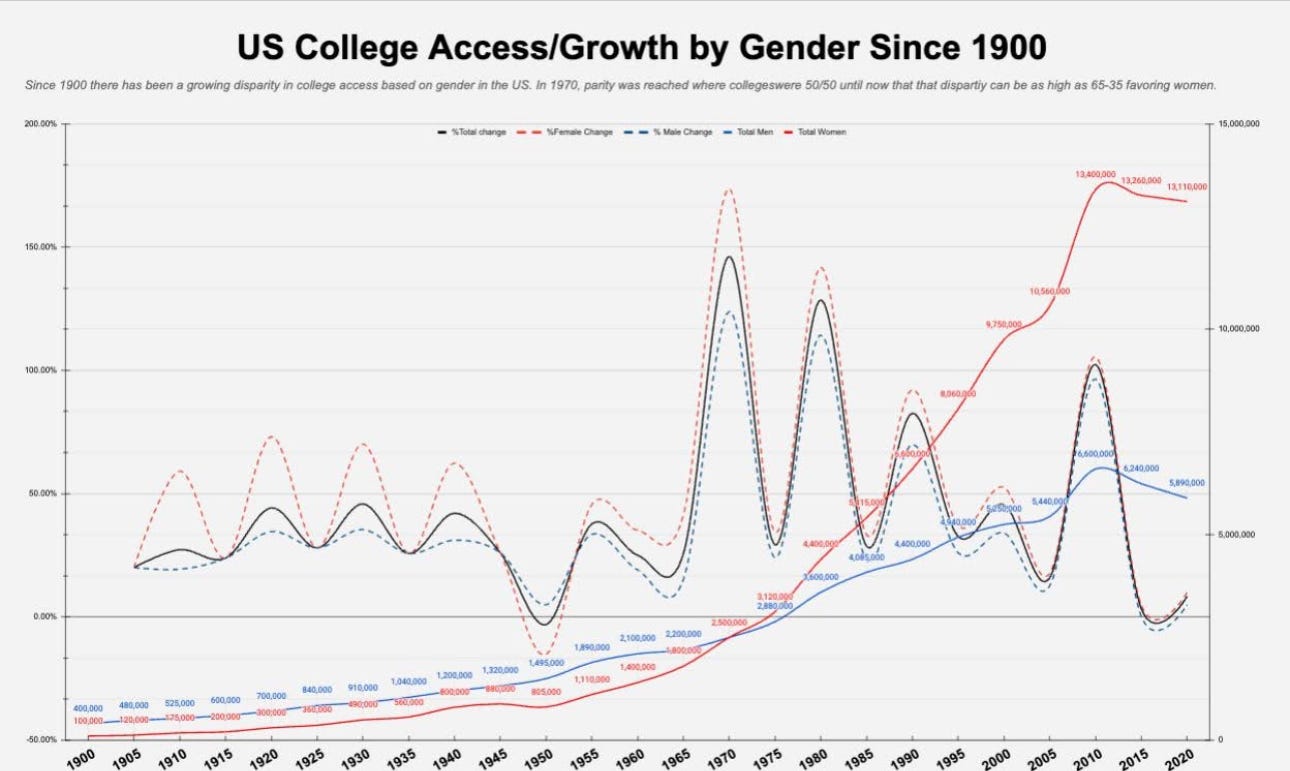
The result was predictable. Tuition skyrocketed. Administrative bloat exploded. Between 2015-16 and 2024-25, non-faculty staffing at North Carolina’s public universities grew by 14.6% while enrollment rose only 10.2% — a gap that represents a massive transfer of resources from instruction to administration. Nationwide, the fastest-growing salary categories in higher education are now research (86.5% growth), communications and fundraising (81.1%), and fiscal affairs (90.9%) — not teaching.
Meanwhile, the curriculum shifted from hard skills — things that could be tested against reality — to soft skills and fields whose value cannot be verified in the market but only asserted by the institution.
The systemic loop entered the Derivatives stage: the credential began trading against itself, detached from any underlying collateral. Grade inflation accelerated. Standards collapsed. And the individual, still anxious, still seeking an instrument, borrowed more and believed harder.
The credential was no longer a certificate of competence. It was a bearer bond — a piece of paper whose value depended entirely on collective belief, not on any underlying asset.
Part II: The Inflation
When the Derivatives Stage Goes Parabolic
If the degree is a currency, then grade inflation is counterfeiting. And by that measure, American universities have been printing money for forty years.
The data is stark. And it’s not just in the US. In the United Kingdom, the proportion of “First Class” degrees rose from 7% in 1994 to 36% in 2022. In the United States, the number of students awarded first-class degrees at English universities was 15.8% in 2010-11 but had “more than doubled” to 37.7% in 2020-21, before falling back to 28.8% in 2023-24. This is not because students are smarter or working harder. It is because universities have a structural incentive to keep customers — students and their parents — satisfied.
The mechanisms of inflation are now being exposed by regulators. The UK Office for Students has identified “inherently inflationary practices” including the use of multiple algorithms to determine a module’s mark and the discounting of a student’s lowest scores. At St Mary’s University, Twickenham, a change from a single classification algorithm to multiple algorithms resulted in 79.5% of students receiving a first-class or upper second-class degree — 4.7 percentage points higher than if the old system had been used on the same student cohort. At the University of West London, changes including the discounting of the lowest 20 credits pushed the share of “good degrees” to 85.3%.
This is not education. This is a compliance architecture designed to produce outputs that satisfy regulators and attract tuition-paying customers. It is the systemic loop feeding on itself — derivatives upon derivatives, with no anchor to the real.
Meanwhile, the financial bubble has grown to historic proportions. Total student loan debt in the United States now stands at approximately $1.84 trillion (federal and private combined), held by roughly 42.8 million federal borrowers. The average federal student loan debt per borrower is around $40,000, with a median of approximately $20,000. Students pursuing graduate degrees carry an average of over $100,000 in debt. And roughly 7-8% of student loans are in default at any given time, representing more than $180 billion in delinquent debt.
Students are paying premium prices for a product whose value has been quietly, systematically written down. The individual, still running the anxiety loop, cannot see that the instrument was never the solution — only the bait.
Part III: The Bubble
Why No One Called the Margin Call (Until Now)
In a normal market, when a product’s price diverges from its value, arbitrageurs step in. They short the overpriced asset. They expose the fraud. The bubble pops.
But education has never been a normal market. Three structural features kept the credential bubble inflated for decades — each a feature of the systemic loop’s Intermediate stage.
First, signaling. Even if you learn nothing in college, the degree still signals something — not competence, necessarily, but conformity, class background, and the ability to show up on time for four years. Employers used the degree as a filter because it was cheaper than testing every applicant themselves. The signal was weak, but it was the only signal available.
Second, regulatory capture and legal cover. This is the hidden variable that most analyses miss. Employers did not use degrees because degrees predicted performance — decades of industrial psychology show they don’t, beyond a very low threshold. Employers used degrees because they were legally defensible.
The 1971 Supreme Court case Griggs v. Duke Power changed everything. Duke Power had required a high school diploma and passing scores on two IQ tests for transfer out of its lowest-paying department. The Court ruled that employment tests must be “reasonably related” to the job — but more importantly, it placed the burden of proof on the employer to show that any requirement with a “disparate impact” was a “business necessity.” In practice, this made employers terrified of designing their own competence tests. A test that accidentally disqualified too many protected applicants could trigger a class-action lawsuit, regardless of whether the test actually predicted job performance. But a degree requirement? That was safer. It had the imprimatur of institutional authority. It was harder to challenge. And if challenged, the employer could point to the degree as a neutral, third-party certification rather than a test they designed themselves.
The degree wasn’t a signal of competence. It was a hedge against liability — the hiring market’s version of a credit default swap. Employers weren’t buying protection against employee failure. They were buying protection against being accused of unfair selection. The university was the counterparty. The degree was the derivative. And the legal system was the collateral.
This explains why the bubble persisted so long after everyone knew it was a bubble. The system was collectively reinforcing a fiction because the alternative — actually testing competence — opened employers to expensive litigation. Risk wasn’t mispriced. It was legally displaced. And the degree was the instrument that absorbed it.
Third, debt lock-in. Once you borrow $100,000 for a degree, you have a powerful incentive to believe that degree is valuable. Admitting that the credential is worthless means admitting that you are insolvent. So you double down. You go to graduate school. You take on more debt. You chase more credentials. The individual loop enters a feedback spiral: anxiety drives leverage, leverage drives more anxiety, and the systemic loop collects at every turn.
But bubbles do not burst because people finally admit they were wrong. Bubbles burst because the underlying collateral stops performing. The systemic loop’s Derivatives stage cannot sustain itself forever. Eventually, the margin call arrives.
Part IV: The Trigger
AI as the Margin Call
For forty years, the credential bubble survived because the labor market had no cheap alternative. If you needed a contract drafted, you had to hire a lawyer. If you needed a diagnosis, you had to see a doctor. If you needed code written, you had to find a coder. The guild power of credentialed professionals was protected by the high cost of acquiring their skills.
Large language models have just broken that monopoly. Early evidence suggests that the workers most exposed to AI displacement are not low-skill, low-wage laborers. They are the highly educated, highly paid white-collar professionals, mostly in compliance-driven roles, who were previously considered safest. (Augmentation remains the dominant near-term story in many fields, but the direction is clear.)
Anthropic’s 2026 labor market impact study, based on actual Claude usage data rather than theoretical exposure models, found that the workers with the highest “observed exposure” to AI are those with bachelor’s degrees (23.8 percentage points higher than unexposed workers) and graduate degrees (12.8 percentage points higher, a fourfold increase). High-exposure workers earn 47% more per hour than unexposed workers ($32.69 vs. $22.23). The jobs with the highest actual AI exposure include computer and mathematical occupations, business and financial operations, and legal professions — the very careers that students incur six-figure debt to enter.
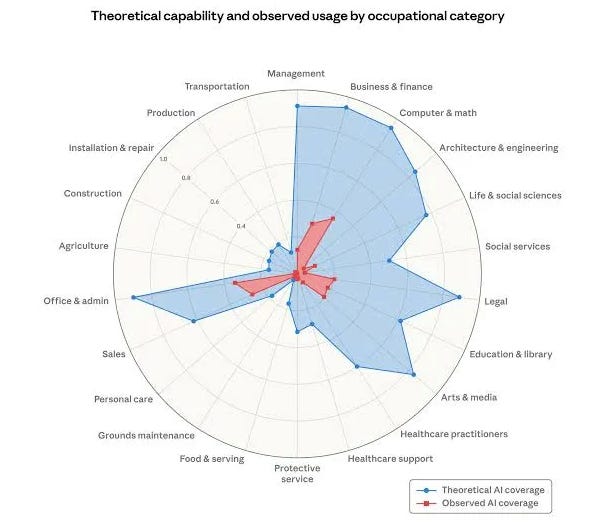
The jobs least exposed to AI are those requiring physical presence and manual skill: chefs, motorcycle mechanics, construction workers, farmers, electricians, plumbers. The plumber is now more AI-proof than the paralegal. The electrician has more job security than the marketing director.
This is the margin call. The systemic loop has reached Stage 6. When you borrow against an asset — in this case, your future earnings — and that asset loses value, the lender asks for more collateral. But you have none. Your degree, which you thought was equity, was actually debt. And now it’s underwater.
For the individual still running the anxiety loop, the collapse is sudden and total. The instrument — the degree — no longer resolves the anxiety. It may even be the source of it.
Part V: The Restructuring
What Happens When the Credential Dies
The death of the degree will not happen overnight. Institutions have enormous inertia. Accreditation bodies protect incumbents. Student loan forgiveness programs delay the reckoning. The systemic loop is entering Stage 7 — restructuring — but restructuring is never clean.
The direction, however, is clear. Employers are already shifting. While 19.3% of U.S. job postings still required a bachelor’s degree in November 2025 — up from 16.6% in 2023 — the longer-term trend is toward skills-first hiring. Even within the same job titles, degree requirements have been declining since 2019 when adjusted for occupational mix. Twenty-five percent of employers surveyed reported eliminating bachelor’s degree requirements for some roles by the end of 2025, and seven in ten hiring managers said their company prioritizes relevant experience over a degree. (The shift is more rhetorical than transformative in actual hiring volumes, but the direction is unmistakable.)
The signal is shifting from the credential to the demonstrated skill. The systemic loop is being forced to re-anchor itself to something real.
Universities will respond in one of two ways. The first is doubling down: more administrative bloat, more expansion of disciplines that cannot be tested against market reality, more debt-funded consumption. This path leads to bankruptcy, irrelevance, and, eventually, closure — a final collapse of the individual loop for millions of students. These disciplines are not targeted for political reasons. They are targeted because they have no market bid. They are derivatives that have lost all reference to an underlying asset.
The second is restructuring: stripping away the non-performing departments, returning to a focus on hard skills, real testing, and market-verified competence. This path leads to a smaller, leaner, more honest institution — one that might actually resolve the anxiety it claims to address.
The smart money is on a split. Elite universities will survive the margin call not because they teach better (many don’t), but because they sell something AI cannot replicate: exclusivity, network effects, and the credential as a positional good. Their value was never really the lecture content. It was the admissions office. That is a different asset class entirely. But for the other 90% of institutions — the regional public universities, the non-selective private colleges, the for-profit degree mills — the reckoning will be brutal.
Part VI: Breaking the Loop
What the Individual Does Now
If the credential is no longer a reliable signal, what replaces it? The answer is not another piece of paper. It is not a micro-credential, a bootcamp certificate, or a LinkedIn badge. Those are just smaller units of the same fiat currency — the systemic loop repackaging itself to capture the next wave of anxiety.
What replaces the credential is demonstration. And demonstration breaks the individual loop at its source.
Consider what demonstration looks like in practice: A self-taught developer whose GitHub portfolio and shipped open-source tools land freelance contracts — no computer science degree required. An apprentice electrician who builds a verifiable client list through word-of-mouth and local reputation — no four-year university needed. A nurse who learned through direct clinical practice and mentorship, not just coursework and exams — competence verified by outcomes, not credentials. These are not exceptions. They are the leading edge of a structural shift.
The individual loop runs: Anxiety → Instrument → Institution → Leverage → Collapse. The degree was the instrument. The university was the institution. Debt was the leverage. The collapse is now underway.
To break the loop, you must short-circuit it at the instrument stage. Do not reach for another credential. Reach for a skill. Reach for a portfolio. Reach for a problem you can solve.
Can you do the thing? Can you prove it? Can you point to work you have actually done — not a grade you were given, not a degree you paid for — but a bridge you built, a problem you solved, a product you shipped?
In a world of AI, the premium shifts from credential-holding to competence-demonstration. The person who can actually fix the generator, write the code, diagnose the patient, or frame the house will always have leverage. The person who can only produce a diploma will have none. The individual loop, when anchored to real competence rather than institutional approval, becomes self-terminating: anxiety is resolved not by an instrument but by actual capability.
Your skills are your collateral. Your reputation among people who have seen you work is your credit rating. Your ability to produce results in the physical world is your only non-fungible asset.
The university sold you a certificate. It never owned your hands. It never owned your mind. It never owned your ability to learn, to build, to adapt.
That part is still yours. And that part cannot be securitized.
Conclusion
The margin call on the college degree has been coming for forty years. We inflated the credential, lowered the standards, and borrowed against a future we assumed would always need what we were selling. The systemic loop ran its course — extraction, quantification, securitization, intermediation, derivatives — and now the margin call has arrived.
AI did not create this bubble. It just turned on the lights. It revealed that the underlying collateral — real competence, real skills, real problem-solving ability — had long since been written down to near zero.
Now we can see what was always there: a system that stopped teaching, started signaling, and convinced an entire generation to go into debt for a signal that was never as strong as they believed. The individual loop, running on anxiety and hope, mistook the instrument for the solution.
The question is not whether the bubble will pop. It already is. The question is what you will be holding when it does.
Will you be holding a diploma that no one trusts?
Or will you be holding a skill that no one can replace?
*Data sources: Office for Students (2025), Federal Reserve / The College Investor (2026), Indeed Hiring Lab (2026), Anthropic (2026), Carolina Journal / Martin Center for Academic Renewal (2025), Seyfarth Shaw / Executive Order (2025), Times Higher Education (2025), LinkedIn / Higher Education Policy (2025), Andrews University Student Movement (2026), National Center for Education Statistics (2024).*
Great stuff, Patrick. As a businessman who transitioned to academia and worked with Clay Christensen, I have been writing and warning about this for years. But very few in HE are listening!!!
My 20 year old is more self educated than I was at age 45. Very little of his education was gained at school. He taught himself subjects he was interested in. The public schools are also useless beyond basic literacy and numeracy.